
Home / Pest Library / Ants
Ants in Delaware: How to Spot Them and Get Rid of Them
Odorous house or pavement ants in your kitchen? Learn how to tell them apart, why baits beat sprays, and how Wolfe Pest Control treats ants in Kent County.
Quick facts
- Odorous house ants are tiny and smell rotten when crushed.
- Pavement ants nest in pavement cracks and ground-level masonry.
- Baits work better than spraying because workers carry them back to the queens.
- Bait can take two weeks or longer to work through a colony.
What they look likeSignsAre they dangerous?How we treat themPreventionFAQ
What do they look like?
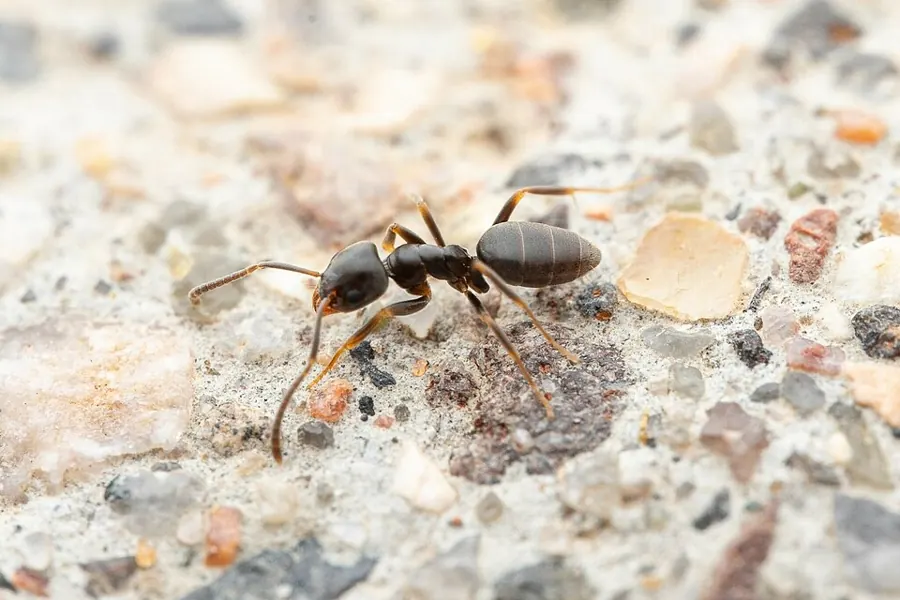
Two small ants that show up in kitchens are odorous house ants and pavement ants. Odorous house ant workers are tiny, about 1/16 to 1/8 inch long, brown to black, and all the same size. Crush one and you'll notice a rotten smell, which is the easiest way to tell what you have. Pavement ants are about 1/8 inch long and dark brown to blackish. They nest under stones, in pavement cracks, and next to buildings.
Signs you have them
- Fast, single-file trails of tiny ants heading to sweets
- A rotten smell when you crush one (odorous house ants)
- Winged ants from May to July (odorous house ants)
- Ants coming up from pavement cracks, slabs, or ground-level masonry walls
- Ants in pantry food, crumbs, or grease
Are they dangerous?
Pavement ants don't carry a public health risk, but both kinds get into food. Odorous house ants contaminate stored pantry items, and pavement ants will eat almost anything, from seeds and bread to meat and cheese. Colony size is the bigger problem. Odorous house ant colonies often have several thousand workers and many queens, so the ants you see are only a small part of the nest.
When are they active?
Odorous house ants send out winged ants from May to July.
How Wolfe treats them
For odorous house ants, we use baits labeled for sweet-loving ants and place them where the ants are working. Foragers carry the bait back and share it with the queens. It can take two weeks or longer to see full results. For pavement ants, we also look at the cracks and slab edges where they nest. All of our work comes with a 30-day warranty. If pests come back within 30 days of a treatment, call us and we'll come back out at no extra charge.
How to keep them out
- Wipe up crumbs and spills, and keep sweets sealed.
- Seal cracks in the foundation and around the house.
- Trim plants back so they don't touch the house.
- Get rid of standing water near the house.
- Move firewood and building materials away from the house.
Common questions
Why do these ants smell when I crush them?
That rotten smell is a trait of odorous house ants. Penn State Extension uses it as a key way to identify them.
Why not just spray the ants I see?
Odorous house ant colonies can have thousands of workers and many queens. Baits work better because the workers carry them back to the nest.
How long until the ants are gone?
Bait can take two weeks or longer to work through the colony. If ants come back within 30 days of a treatment, call us and we'll come back out at no extra charge.
Are pavement ants found in Delaware?
Yes. The University of Delaware Cooperative Extension has a fact sheet on pavement ants feeding on vegetable transplants.
Sources: Penn State Extension: Odorous House Ant; PestWorld (NPMA): Pavement Ants; University of Delaware Cooperative Extension: Pavement ant feeding on vegetable transplants
Last reviewed October 2026 by Wolfe Pest Control.
Seeing something? Call us.
(302) 697-8969Office hours: Monday to Friday, 10am to 3pm
All contact details