
Key takeaways
- Make sure it's termites and not flying ants.
- Termites live in the soil, so treatment has to reach the soil.
- Tearing out damaged wood doesn't get rid of the colony.
- Wolfe treatments come with a 1-year termite warranty that transfers if you sell.
Is it termites or flying ants?What are you up against?How does liquid soil treatment work?Can you get rid of termites yourself?How does Wolfe get rid of termites?When should you call us?
Is it termites or flying ants?
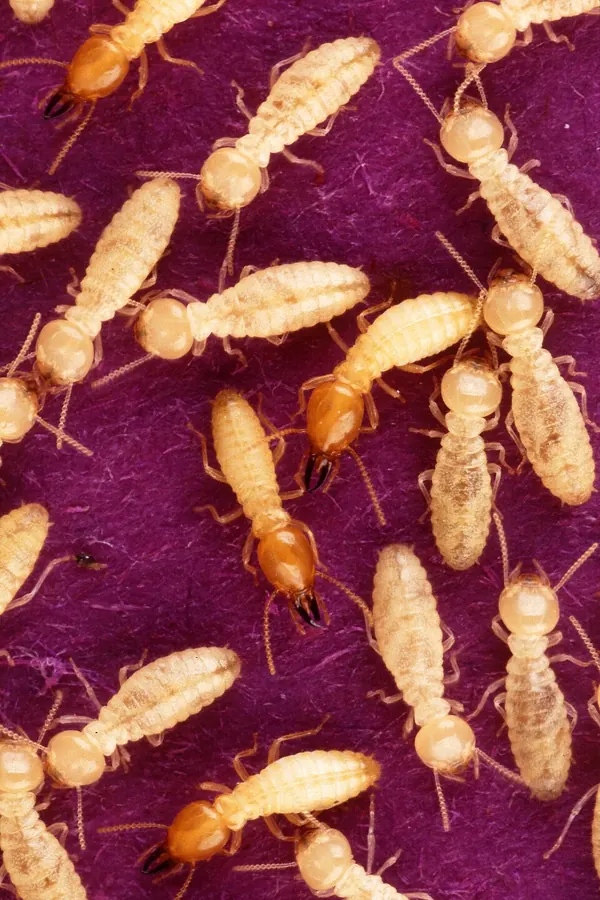
Termites have a thick waist, straight antennae, and two pairs of wings that are the same length. Ants have a pinched waist, bent antennae, and front wings longer than the back ones.
If you can, save a few of the bugs or wings in a sealed bag. It helps us tell what you're dealing with.
What are you up against?
The termites you see are a small part of the colony. A colony can hold 100,000 to 1,000,000 termites, and they can travel up to 150 feet from the nest to find food.
Most of the colony stays in the soil. That's why pulling out damaged wood doesn't solve the problem.
How does liquid soil treatment work?
Our termites live in the soil and tunnel up into wood, so we treat the soil. We apply a liquid termiticide to the soil around the foundation. Depending on the house, we do that by trenching, rodding, or drilling through concrete.
Purdue Extension notes that liquid treatments start working right away. Over time, digging, grading, and weather wear treated soil down, which is why the yearly inspection matters.
Can you get rid of termites yourself?
Penn State Extension advises against do-it-yourself termite treatment. Store products can kill the termites you see, but getting product into the soil all the way around a foundation takes equipment and training.
What you can do is fix the things that draw termites in. Keep wood off the soil, move firewood away from the house, and keep water draining away from the foundation.
How does Wolfe get rid of termites?
We start with an inspection ($150, waived if we do your treatment). If termites are active, we explain what we'd do and give you a quote. Then we treat the soil around your foundation. We use EPA-registered products applied according to the label, and we'll tell you when kids and pets can go back into treated areas.
Our termite treatments come with a 1-year termite warranty. After the first year, you can keep it active with a yearly inspection and renewal fee. If you sell the house, the termite warranty transfers to the new owner.
When should you call us?
Call us if any of these sound familiar. A termite inspection is $150, and we waive it if we do your treatment. Call us at (302) 697-8969 to set one up.
- You saw a swarm of winged bugs inside.
- You found mud tubes on the foundation, posts, or sills.
- Wood sounds hollow when you tap it.
- You're not sure what the bug is.
Common questions
How fast does termite treatment work?
Purdue Extension notes that liquid soil treatments start working right away. If you see new mud tubes or swarmers later, call us.
Will removing the damaged wood fix it?
No. Most of the colony lives in the soil, so the soil has to be treated.
Is there a warranty?
Our termite treatments come with a 1-year termite warranty. After the first year, you can keep it active with a yearly inspection and renewal fee. If you sell the house, the termite warranty transfers to the new owner.
How much does it cost?
It depends on the property and the pest. Call us and we'll give you a quote.
Sources: Penn State Extension: Eastern Subterranean Termites; UF/IFAS Featured Creatures: Eastern Subterranean Termite (EENY-212); Purdue Extension: Subterranean Termites (E-4)
Seeing something? Call us.
(302) 697-8969Office hours: Monday to Friday, 10am to 3pm
All contact details